
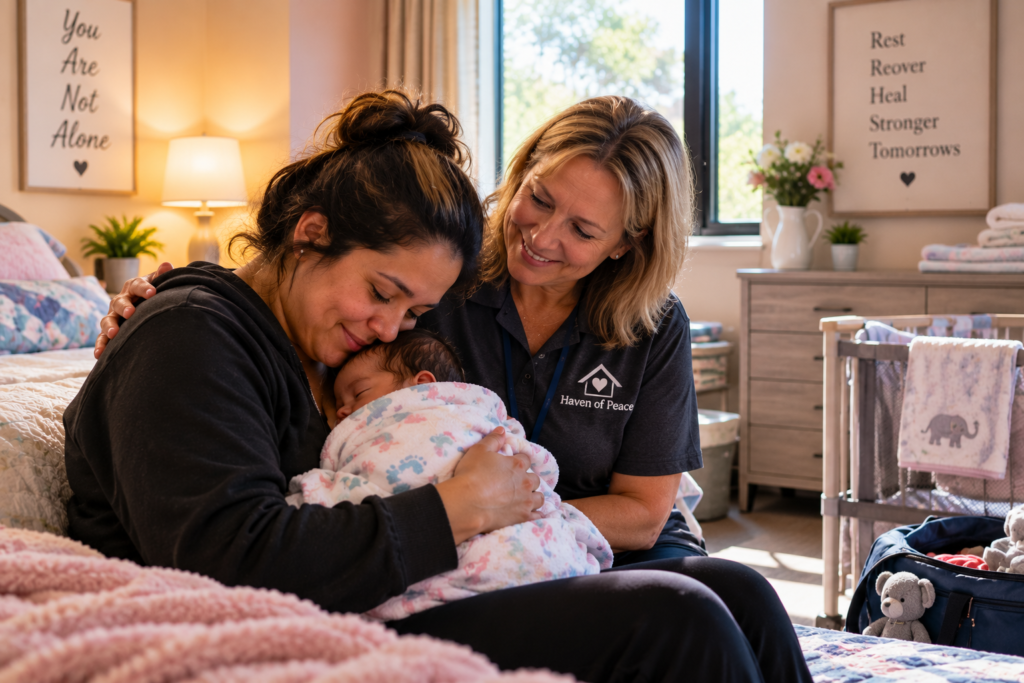
New Haven of Peace Rooms Give Women in Crisis Something More Than a Place to Sleep
undle beds, dressers and baby-changing tables.
Assistant Director Tonya Cooper told KCRA that the space could be used by a pregnant woman returning from the hospital who needs to isolate or by someone who is contagious during flu season. About four families had already used the rooms before the center formally opened.
But the two rooms are only one part of what happens after a woman arrives at Haven of Peace.
A Safe Place Can Be the Beginning, Not the Destination
Haven of Peace can shelter up to 35 women and children.
A normal emergency stay is two weeks, but women who work with a case manager and make progress toward self-sufficiency goals may receive extensions of up to six months.
What happens during that time depends on the individual woman and what brought her to the shelter.
Haven says residents receive individualized case management to identify personal goals, address barriers and develop a path toward greater independence.
That can include financial-literacy training, job preparation, counseling and connections to other community resources.
For a woman looking for work, the assistance can become very practical. Residents can receive help writing a résumé, completing job applications, practicing for interviews and learning how to search for employment.
Women who need specialized help involving domestic violence, substance abuse or mental-health concerns can also be referred to other agencies.
What Happens When the Emergency Stay Ends?
For some women, the next step may include transitional or supportive housing.
Haven describes transitional housing as temporary housing for residents moving beyond an immediate crisis while continuing to work toward self-sufficiency. Its supportive housing program offers longer-term housing options along with continued assistance involving employment, life skills and community resources.
Both include case management and preparation for independent living.
Those programs should not be understood as a guarantee that every woman entering Haven’s emergency shelter will receive housing afterward. Haven’s published information does not provide enough detail to determine current availability or how residents are selected for those housing options.
But the existence of a next step matters.
For a woman leaving domestic violence, entering a shelter can itself be an act of taking back control.
For someone experiencing homelessness, accepting temporary help with housing, employment or everyday needs does not necessarily mean surrendering independence.
Sometimes temporary support is what makes independence possible again.
The New Rooms Create Something Crisis Often Takes Away
The Roos Family Health and Wellness Center does not solve Stockton’s affordable-housing shortage.
Two private rooms cannot guarantee a woman a job, permanent housing or an easy path out of the circumstances that brought her to Haven of Peace.
But they can provide something immediate and deeply practical: privacy, dignity and room to recover.
Inside those rooms, a mother can care for her newborn away from a communal dormitory. A woman recovering from illness can have space to rest. Someone who needs temporary separation for health reasons does not necessarily have to lose access to the shelter because she needs a different environment.
And while she is there, the larger work can continue.
She can meet with a case manager. Identify barriers. Prepare for employment. Learn new skills. Connect with resources. Begin making decisions about what comes next.
That is why the new rooms represent something more than additional shelter space.
For a woman whose control over everyday life has been disrupted by homelessness, violence or crisis, having a private place to recover can become one small but meaningful part of taking that control back.